1. Introduction: The Universal Quest for the Unseen
For millennia, the “inevitable specter of death” has loomed as the ultimate ontological threshold, haunting the human imagination with a primal sense of awe and dread. Unlike the animal kingdom, which lives in the immediate pulse of the present, humanity has always sought to decode the mists of time, asking the oldest of questions: What happens when we die?
This fundamental anxiety gave birth to the “Mystery Cult”—esoteric circles offering more than mere dogma. These were liminal spaces of personal transformation where secret knowledge was the currency of salvation. From the subterranean chambers of Dacia to the hallowed halls of Eleusis, these ancient traditions shared a profound, counter-intuitive understanding of the soul’s journey, suggesting that the “abyss” of death is not a wall, but a gateway to a higher mode of being.
2. The Great Relocation: Zalmoxis and the End of Death
Lesson: Death is not a cessation of being, but a change of habitation.
In the ancient Geto-Dacian worldview, mortality was viewed through a lens of radical certainty. Herodotus recorded that the Getae were “the bravest and most righteous” because they believed they were immortal—a conviction rooted in the teachings of Zalmoxis. While the Greeks of the Hellespont skeptically whispered that Zalmoxis was merely a former slave of Pythagoras who brought “Ionian usages” to a “simple-witted folk,” Herodotus himself doubted this chronology, suspecting Zalmoxis lived long before the Samian philosopher.
To prove his doctrine of the soul’s survival, Zalmoxis utilized the technology of “occultation.” He vanished into a subterranean chamber—likely a cave on the holy mountain Kogainon—for three years. While his people mourned him as dead, he existed in a state of ritual hiding, only to re-emerge in the fourth year. This “epiphany” served as a visceral proof of his teaching: that life does not end, but merely relocates to a realm of eternal happiness.
“They believe that they do not die but that he who perishes goes to the god (daimon) Zalmoxis… death was just a change of habitation.”
3. The Logic of the Spear: A Message to the Gods
Lesson: Sacrifice is a ritual technology for the renewal of divine relationships.
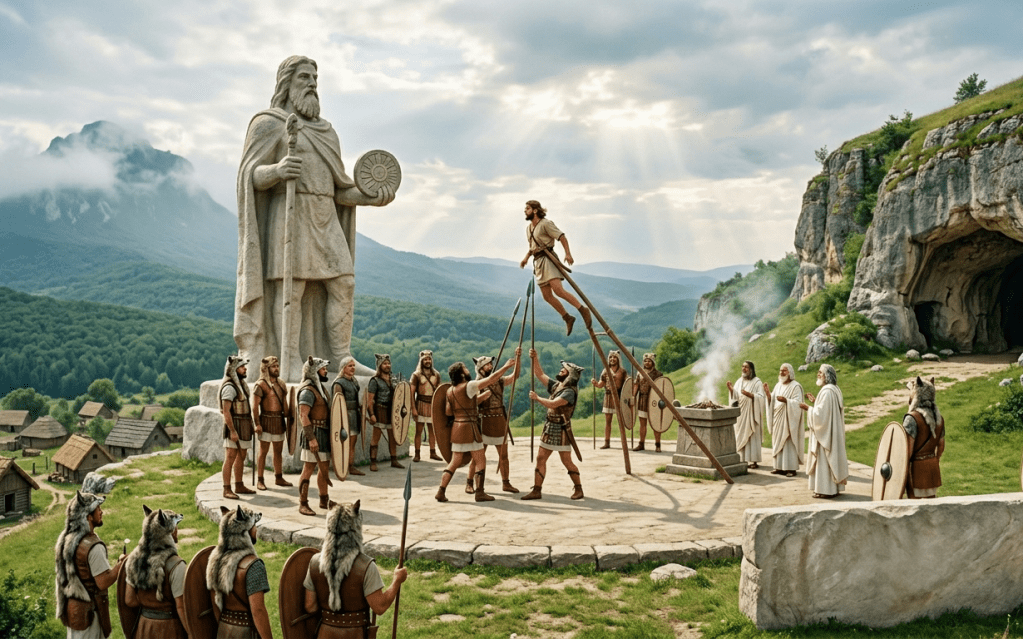
Perhaps the most startling manifestation of this belief was the messenger sacrifice. Every five years, the Getae chose an individual by lot to communicate their communal needs to Zalmoxis. The ritual was precise and vocal; the messenger was told the requests while he was still alive, ensuring the communication was intentional. He was then hurled aloft onto the points of three spears.
In this sacred logic, death was a sign of divine favor. If the messenger died upon the spears, it was a hierophany—a manifestation of the sacred—confirming the god had accepted the message. If the man survived, he was deemed a “bad person” and replaced. This was not an act of cruelty but a necessary “ritual renewal of a relationship” between the human and the divine. It suggests the boundary between worlds is so thin that the passage from one to the other is a vital instrument for maintaining cosmic order.
4. The Radical Democracy of Eleusis
Lesson: The soul possesses a universal value that transcends social hierarchy.
The Eleusinian Mysteries provided a unique “democratic spirit” in an otherwise stratified Mediterranean world. Unheard of for the time, the rites were open to men, women, slaves, and foreigners. This inclusivity suggested a radical spiritual truth: the soul’s capacity for transformation is a human universal, independent of social station or blood guilt.
Using the framework of the “hero’s journey,” the initiatory process at Eleusis represented the “abyss” phase of personal transformation. By witnessing the mythic drama of Persephone’s descent and return, the initiate moved from profane existence into a state of spiritual rebirth. As Mircea Eliade noted, these rituals allowed the initiate to transcend linear time and enter a primordial reality.
“[Such rites allowed initiates to] experience sacred time – a return to the mythical age when the gods walked the earth.”
5. Ecstasy as a Technical Tool: The Dionysian Dissolution
Lesson: Spiritual wholeness requires the reconciliation of ecstatic dissolution and intellectual discipline.
The ancient seeker had two distinct paths to the divine. On one hand lay the Dionysian Mysteries, centered on enthousiasmos (divine possession). Participants sought the “dissolution of boundaries” through frenzy and ritual intoxication, a “wild” release from social constraints that allowed the soul to merge with the indestructible life of the god.
This stood in stark contrast to the Orphic Mysteries, which followed a path of intellectual and ascetic purification. Orphic initiates adhered to a strict moral code and carried “Gold Tablets” in their graves—manuals of instruction for navigating the afterlife and escaping the cycle of reincarnation. While the Dionysian path offered a temporary “death” of the self through ecstasy, the Orphic road was a disciplined “road of trials” toward spiritual enlightenment. Together, they provided a vital spiritual technology for the Greeks to navigate both the chaos of the unconscious and the order of the soul.
6. The Wheat of Osiris: Life Born from the Abyss
Lesson: Destruction is the fertile prerequisite for cosmic continuity.
The thematic link between death and regeneration reaches its zenith in the Egyptian Mystery Play of the Contending of Horus and Set. This cosmic battle between order (Ma’at) and chaos was reenacted to ensure the fertility of the land. At the Temple of Philae, the imagery is profound: wheat is depicted growing directly from the body of the murdered god Osiris.
This symbolizes the “reconciliation of opposites” that Joseph Campbell identified as central to the human psyche. The murder and dismemberment of Osiris are equivalent to the sowing of the seed; his resurrection is the harvest. This was the “myth of eternal return,” where death is recognized as the fertile soil for new life, ensuring that the cosmic cycle remains unbroken.
“[These agricultural symbols are manifestations of the] myth of eternal return, where rituals reenact the original creation to renew time and ensure continuity.”
7. Conclusion: The Night Eternal and the Dawn
The ancient mystery cults were not merely preoccupied with the end of life; they were preoccupied with the courage required to live in the face of it. The complexity of these beliefs is captured in the dark poetic tension of Mihai Eminescu’s “A Dacian’s Prayer.” While some sought a place of “all good things,” Eminescu’s speaker begs for the ultimate rest—to have his “stony pillow” stolen, his “fountain of tears” exhausted, and to be “traceless dispelled” into the “night eternal.”
Whether seeking the ecstatic heights of Dionysus or the silent, traceless rest of the abyss, the ancients approached the transition of death with a sense of ritual preparation that modern life has largely abandoned. In our age of digital permanence—where we curate an immortality of data and images—do we still possess the ancient courage to see death not as a clinical end, but as a profound, transformative dissolution?
 Magick with Alex
Leave a comment