
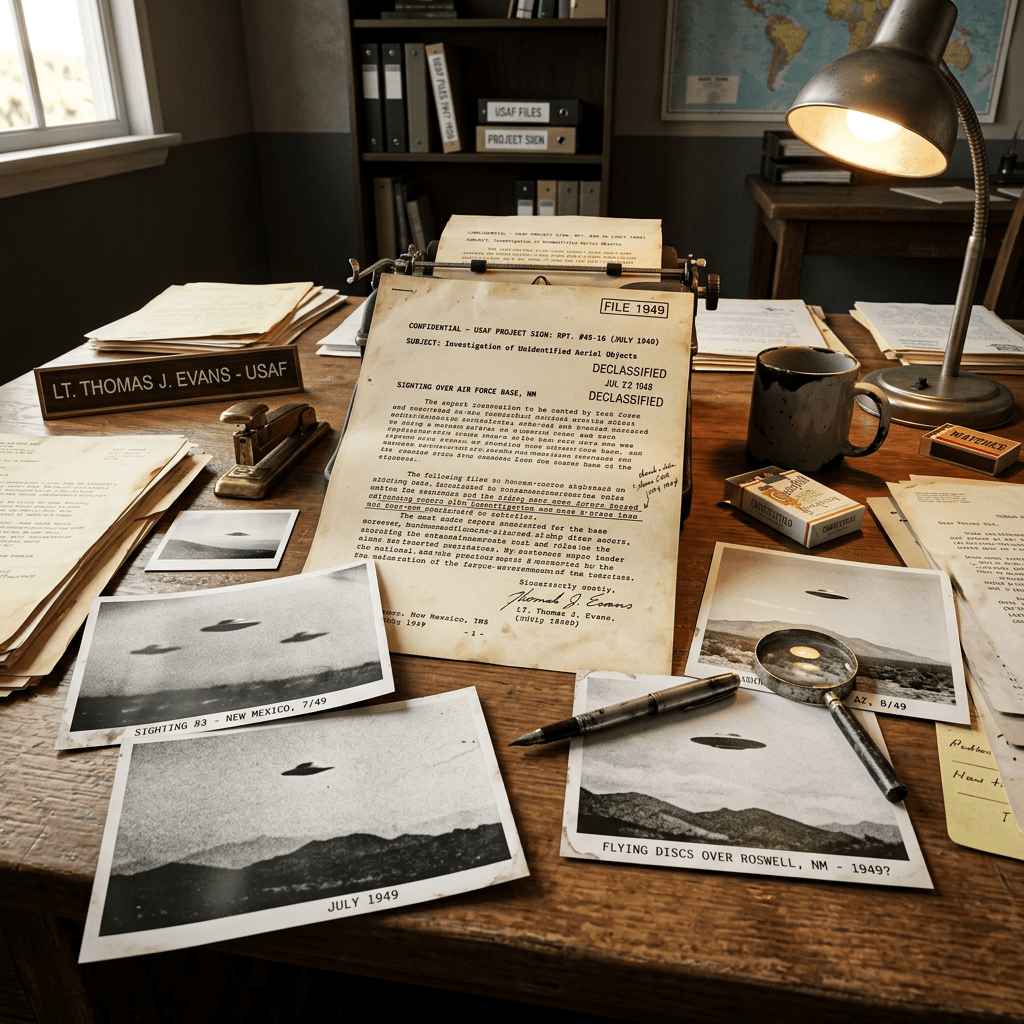
In the taut, shivering atmosphere of 1949, the American consciousness was a drum stretched tight by the burgeoning Cold War. As the atomic age matured, J. Edgar Hoover’s Bureau found itself grappling with a new, ethereal brand of internal security threat: the “Flying Saucer.” Declassified archival files, thick with the purple ink of “RECORDED” stamps and the frantic scrawl of bureaucratic marginalia, reveal a government caught in a peculiar pincer movement. On one side was the rigid requirement of institutional skepticism; on the other, a deluge of “URGENT” teletypes describing the impossible. These documents represent more than just a collection of oddities; they are a paper trail of a nation’s post-war anxieties, meticulously filed, indexed, and occasionally, dismissed with a trembling hand.
The Blond Venusians and the Radar Station Gate
The most sensational narratives often began not with a blurry photograph, but with a secondhand account buried in a “SECRET” Air Force staff message. One January 1950 report details a conversation involving Rudy Fick, a well-known Kansas City auto dealer, who recounted a story told to him by a man named Coulter. According to the document, Coulter had “Crashed the Gate” at a radar station near the New Mexico/Arizona border, where he claimed to have seen the remains of two “highly secret” disks.
The technical descriptions provided were jarringly specific for the era. The craft were 18 feet in diameter, constructed of a metal resembling aluminum that “defied analysis,” and featured a cockpit containing an “automatic calendar” clock that rotated every 28 days. Yet it was the occupants that truly challenged the Bureau’s filing system. Coulter described beings that were three feet tall, blond, and beardless, preserved in a state that seemed to mock the biological limitations of the time:
“The bodies in the damaged ship were charred, but the other ship’s occupants were in a perfect state of preservation, although dead. All were uniform height of 3 feet; blond, beardless and their teeth were completely free of fillings or cavities.”
While the Bureau often categorized such reports under “Internal Security,” the presence of these files—stamped “CONFIDENTIAL” and circulated to the Director of Special Investigations—suggests that even the most outlandish stories were treated as potential intelligence fodder before they were relegated to the “mental case” drawer.
Strategic Terrors: The “Flying Newspaper”
While some saw aliens, others saw opportunity. In October 1949, Maurice E. Hatten of Circleville, Ohio, sent a letter to Hoover that suggested the saucer phenomenon was the perfect vehicle for psychological warfare. Hatten didn’t just suggest using “flying disks”; he proposed a specific delivery mechanism: “finned, cardboard disks” or small balloons designed to mimic the reported phenomena.
His goal was to bypass the Communist Party’s information blockade by dropping “American printed statements” into the USSR. Hatten’s “flying newspaper” concept was a calculated attempt to “confuse and terrify” Soviet leadership. Interestingly, the archival trail shows Hoover returning the letter on October 12, 1949, dryly noting that the Bureau had no jurisdiction. It is a classic archival irony: the Bureau would spend months investigating “blond Venusians,” yet they summarily dismissed a concrete proposal to weaponize the very hysteria they were documenting.
The Convergence of Radiation and Epidemic
In September 1949, the Indianapolis field office produced a memorandum that captured the intersection of two great American fears: the unknown of the skies and the terror of the polio epidemic. Dr. Richard K. Parrish of Decatur, Indiana, posited a theory that the polio cases ravaging his community were actually the result of “uranium poisoning” from flying saucers.
Parrish pointed to sightings observed in the Carolinas in 1948 and near Decatur around July 1, 1949, as the source of the “radiation.” Though the Indiana University Medical School treated the theory as “a big joke,” the FBI recorded it faithfully. This document highlights a moment where professional logic buckled under the weight of the Atomic Age, seeking to explain a known medical crisis through the lens of a new, technological mythology.
“What have done re it?”: The Bureaucracy of Dismissal
The physical reality of the FBI’s skepticism is best seen in the margins of its paperwork. When Ernest Cuneo—a high-level liaison for columnist Walter Winchell—brought the Bureau a report from Peter Cameron Jones, the response was a flurry of activity followed by a sharp, top-down retreat. Jones claimed that in 1947, a silver, “child’s top-shaped” object with transparent windows had knocked him to the ground while he was hiking near Los Angeles.
A July 12 memo regarding the case features a pointed, handwritten scrawl: “What have done re it?” followed by an “URGENT” teletype to the Los Angeles field office. However, after the SAC in Los Angeles reported that Jones was nowhere to be found—his listed address occupied by a manager who had never heard of him—the investigation shifted. In a letter dated July 21, 1949, addressed “Dear Ernie,” Hoover himself diplomatically suggested that Cuneo “consider the possibility that the original letter… may have been a prank.” The Bureau, wary of the “rapid accumulation of very bulky files,” was often more interested in closing a case than solving a mystery.
The Needle over Parkersburg
Of all the reports in the 1949 files, few carried the technical weight of the Sprouse incident. On September 25, 1949, Glen Sprouse, a pilot flying a Luscombe 8A (registration NC 1140K) at 3,450 feet, reported a “bright canary yellow” rocket-shaped object near Lubeck, West Virginia.
What distinguished this report for the “Digital Archivist” is its granular, observational data. Sprouse noted the object was 15 to 18 inches long, traveling at approximately 250 MPH, and lacked any visible means of propulsion. Most strikingly, he described a “needle about 6″ long” at the front of the craft, “the size of a lead pencil.” His technical precision gave the report a credibility that civilian accounts lacked:
“It appeared to have spent it’s force and seemed to be dropping slightly as it passed by, or had been fired or launched from a higher altitude than the altitude I was flying.”
These reports, decorated with “TELETYPE” and “INDEXED” stamps, show a government struggling to categorize the impossible. Each memo was an attempt to fit the inexplicable into a standard filing system. Ultimately, we are left with a fundamental question: If the Bureau’s primary mandate was “Internal Security,” were these files a record of a genuine physical threat, or merely the bureaucratic echoes of a nation’s post-war nerves?


Leave a comment