1. The Journey through the Four Seasons
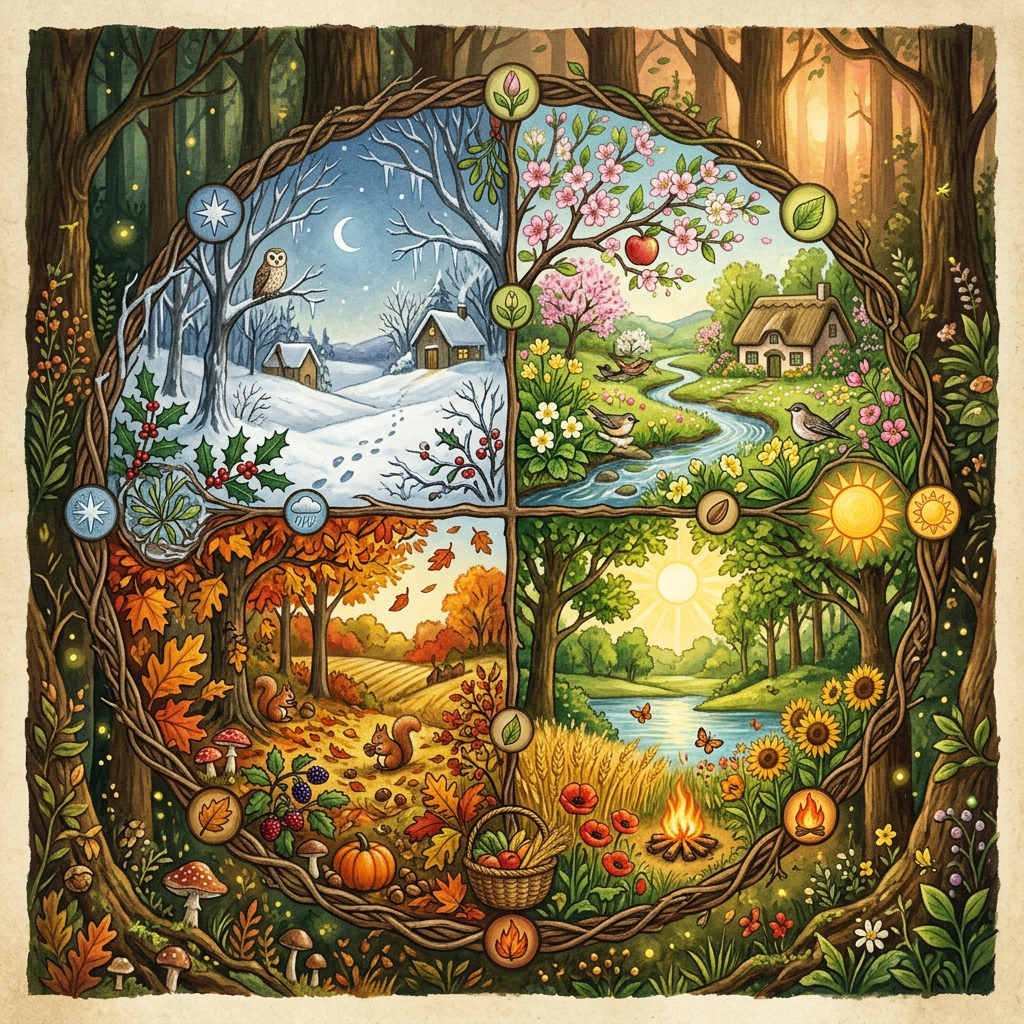
The Wheel of the Year is more than a calendar; it is a conceptual framework that maps the never-ending journey from darkness to light and back again. For the modern practitioner, this cycle provides a symbolic reflection of the birth, death, and rebirth of the gods, mirroring the natural journey of the Sun through the heavens. Understanding these “tides” of the year is essential for the practitioner of spellcraft, as they serve as an incredibly useful guide for determining the most effective timing for any magical endeavor. By aligning our work with these seasonal rhythms, we ensure our personal intent is carried forward by the prevailing currents of the natural world.
2. The Eight Festivals: Quarters and Cross-Quarters
The Wheel is composed of eight seasonal festivals, or Sabbats. These are divided into Quarter Days, which mark the solar milestones where the Sun reaches its highest or lowest points in the sky or crosses the celestial equator, and Cross-Quarter Days, which represent the agricultural and community midpoints between them.
The Divisions of the Wheel
| Quarter Days (Solar Divisions) | Cross-Quarter Days (Midpoints) |
| Yule (Midwinter Solstice) | Imbolc (February 1) |
| Ostara (Spring Equinox) | Beltane (May 1 / May Eve) |
| Litha (Midsummer Solstice) | Lughnasadh/Lammas (August) |
| Mabon (Autumn Equinox) | Samhain (October 31) |
3. Historical Evolution: From Ancient Roots to Modern Synthesis
While many of the festivals within the Wheel have ancient agrarian and folk roots, the unified eight-festival cycle is a relatively modern synthesis. Historically, Celtic practice often focused on the community-oriented cross-quarter days, whereas Anglo-Saxon traditions placed a greater emphasis on the solar quarter days.
The defining moment for the standardization of the modern Wheel was the Repeal of Britain’s Witchcraft Act in 1951. This legal shift allowed figures like Gerald Gardner and researchers like Robert Graves to publicly synthesize and popularize the terminology we use today. This synthesis also preserved vital folkloric mythos, such as the battle between the Holly King and the Oak King. In this symbolic cycle, the Holly King rules over the dark half of the year, finally giving way at Yule to the Oak King, who brings the returning light. Such traditions are often layered with older influences, such as the Roman festival of Saturnalia, which contributed themes of feasting and social subversion to our modern Midwinter imagery.
4. Theoretical Framework: The “Tides” of the Seasonal Year
In the practice of seasonal spellcraft, we view the year as a series of energetic “tides.” This approach is grounded in the “Law of Similarity,” a governing principle of sympathetic magic which posits that “like attracts like.” When a practitioner performs a ritual, they are not merely choosing a date at random; they are seeking to align their “internal intent” with the “external tide” of the planet. Timing a spell to the correct festival allows the practitioner to harness the natural momentum of the season, lending the work more energy than the will of the spellcaster alone could provide.
5. A Seasonal Guide for Spell Timing
To maximize the effectiveness of your magic, align your goals with the specific focus of the current Sabbat:
- Yule (Midwinter): As the longest night gives way to the rebirth of the Sun, the focus is on returning light and new endeavors. It is the ideal time for New Year’s Resolutions and spells for protection, particularly for the home and children. A common folk magic token of this tide is the traditional coin hidden in the Christmas pudding, used to bring luck and wealth to the one who finds it.
- Ostara & Beltane (Spring): Ostara, as an Equinox, is the optimum time for spells requiring balance and mental or physical stability. As the tide shifts toward Beltane, the focus turns to growth and passion. Beltane is a highly sensual festival, perfect for attraction and love magic. Practitioners often utilize Ribbon magic—weaving colored ribbons together to bind an intent—and look to the “balefire” as a powerful vehicle for raising energy.
- Litha (Midsummer): At the peak of solar power, Litha is a time of purification. It is an excellent season for washing away “unwanted baggage” or bad energies in wild bodies of water. Magic at this time often utilizes fresh water and growing flowers to add vitality to spells for renewing existing relationships.
- Samhain (Late Autumn): This is a liminal time when the boundaries between the living and the spirit realms are thinnest. The focus is on honoring ancestors and psychic reflection. Traditional practices include the baking of “soul cakes” as offerings for the deceased or the poor, and it is the proper moment to reflect on ending old cycles to make room for what may come in the next year.
6. Integrating the Rhythms of Nature
A holistic approach to alignment requires the integration of the Wheel with other natural factors. Just as the “tides” of the festivals provide a seasonal roadmap, practitioners use Moon signs—the specific zodiac sign the Moon was in at the time of an individual’s birth—to further personalize a spell. The synergy between the Wheel and lunar phases is vital: the waxing Moon is favored for building intention and growth, while the waning Moon is used for banishing and reflection. The focus now, as it was for our ancestors, remains on the community Sabbat—coming together to give thanks and offering rituals to nature, ensuring our lives remain in harmony with the broader rhythms of the universe.


Leave a comment