
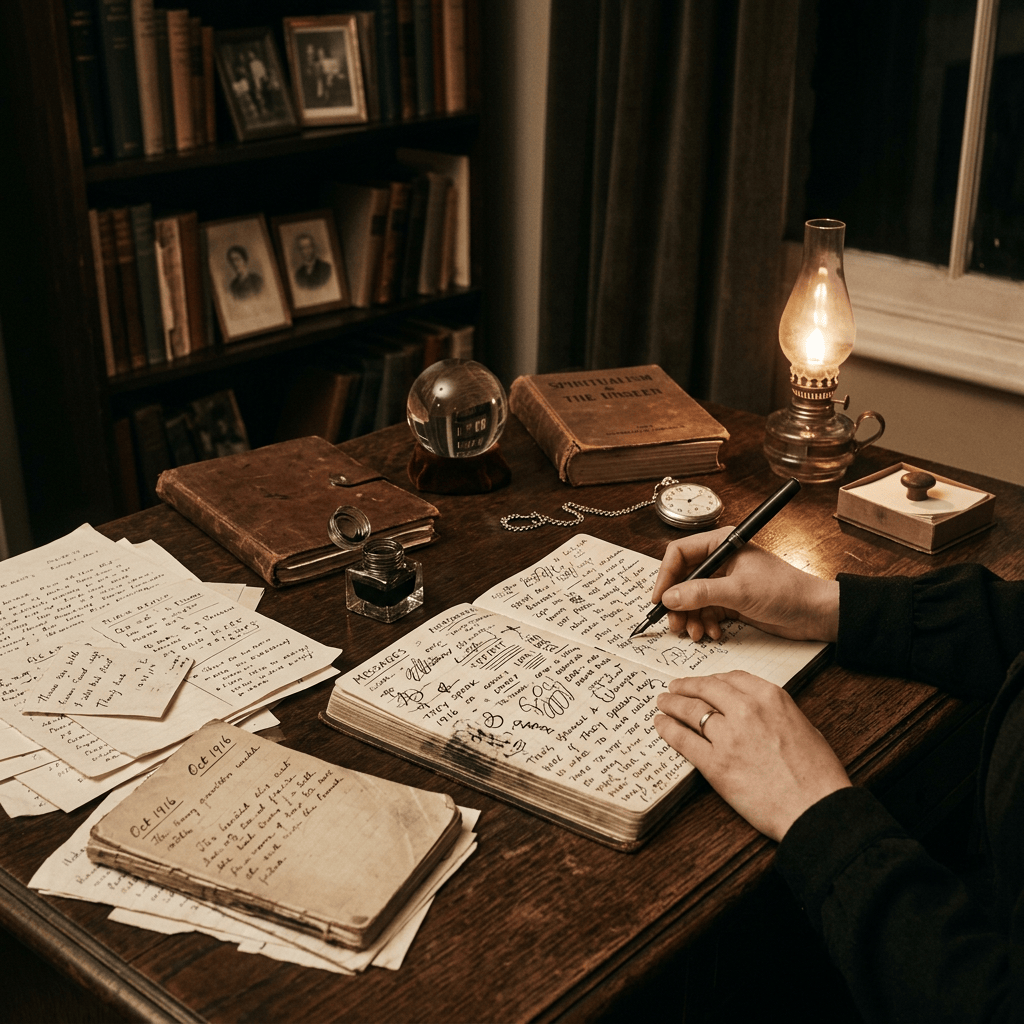
1. Background and Initial Catalyst: The Impact of World War I
Prior to 1916, the entire field of psychical research was completely unexplored territory for L. Margery Bazett. Her entry into automatic writing was not prompted by theoretical curiosity, but by the devastating personal and historical backdrop of World War I, which claimed young lives in rapid succession and directly shattered her family circle.
The immediate catalyst for her investigations was the sudden death of her young relative, Lieut. Frank Thompson, who was killed after being at the Front for a few weeks only. Following his casualty, Bazett experienced a persistent, compelling impression that Frank urgently required her to complete an unfinished task that he had been forced to leave behind due to his sudden deployment and fatal injury. However, executing this task was an absolute impossibility without a specific name and address known exclusively to Frank.
Faced with this apparent impasse, Bazett consulted with a friend and decided to test whether automatic writing could serve as an empirical medium to retrieve the missing evidential data. Skeptical from the outset regarding the possibility of obtaining any genuine supernormal result, she nevertheless instituted strict experimental controls to prevent emotional wish-fulfillment or indefinite trial. She committed to attempting automatic writing for exactly ten minutes a day, at a fixed time, across ten consecutive days before definitively abandoning the experiment.
2. The Breakthrough and Multi-Layered Verification
Physical Manifestation and Immediate Evidence
After nine consecutive days of completely unproductive attempts, the breakthrough occurred on July 24, 1916—the tenth and final day of the experimental protocol. Bazett was amazed when a sudden, powerful physical force resembling an “electric current” rushed through her arm and hand, exerting sufficient kinetic force to throw her pencil across the room. Once this force moderated sufficiently to allow controlled script, the pencil produced a series of specific, verifiable details:
- Full Name: The complete identity of Lieut. Frank Thompson.
- Second Name: The name of Frank’s elder brother, Christopher Thompson. Christopher had been officially reported “missing” in April 1916, leaving his mother, Mrs. Thompson, in agonizing suspense despite continuous enquiry, until an unofficial letter received on July 17, 1916, reported him killed. Obtaining his name alongside Frank’s on July 24 was entirely unexpected.
- Unfinished Task Location: The precise missing name and address required to fulfill Frank’s task. Bazett wrote immediately to this address asking if Lieut. Frank Thompson was known to the household; she received a prompt affirmative reply stating that their son, then serving abroad, had been from time to time in touch with Lieut. Frank Thompson.
Independent Corroborating Evidence
The automatic writing scripts were supported by independent clairvoyant visual phenomena and third-party telepathic impressions occurring outside the writing sessions:
- Waking Vision (July 1, 1916): Weeks before attempting automatic writing, Bazett experienced an early morning waking vision. Thinking of a letter received the previous day regarding Mrs. Thompson’s agonizing suspense over Christopher—who had been missing since April 1916 without official confirmation—Bazett saw Christopher appear in uniform (without a cap) at the foot of her bed. Looking distressed with a puckered brow, he pulled a newspaper from his pocket and scanned the “missing” column where his name had been placed. Looking straight at her, he solemnly and deliberately repeated three times:
“I was killed…it could not have been otherwise, if you had known the circumstances.”
He then walked round to the right side of her bed, coming close enough for Bazett to recognize the distinct personal fragrance characteristic of his breath and person, before vanishing suddenly.
- Third-Party Telepathic Impression (July 25, 1916): On July 25, 1916, Bazett received a letter from Captain P. Marryat, a great friend of Christopher serving in France, who had no knowledge whatsoever of Bazett’s waking vision. Marryat reported that while sitting alone writing to “X-“, he felt Christopher impressing impatient thoughts onto his mind:
“I was sitting in here alone, writing to X-, when it seemed that Chris impressed his thoughts instead of mine. The thought seemed to be…It’s like an impressionist picture…how stupid you are…you can’t find the right words, or really understand…you don’t want to look at the details…this is my message (Christopher’s), not yours.”
In a subsequent clarifying letter dated August 4, 1916, Captain Marryat provided a critical distinction for psychical historians differentiating between full apparitional presences and purely mental or telepathic impressions:
“I had no feeling of Christopher being there, only of Christopher’s thinking, and his impatience seemed to be that I couldn’t find the right words, rather than at the idea; I don’t think I missed that.”
3. Content and Spiritual Philosophy of Early Messages
During the autumn of 1916, Bazett received numerous written scripts from Christopher Thompson. These communications formulated a distinct spiritual philosophy regarding post-mortem existence, perception, and spiritual agency:
- Transition and Personality: Christopher characterized bodily death as a liberating transition matching his known earth-life mannerisms:
“Dying is really rather fun, you know, as we are so much happier here, and much freer to do lots and lots of things. You have no idea.”
When shown this script, Captain Marryat remarked, “That strikes me as like Chris,” confirming the persistence of individual personality traits.
- Perception over Sight: When asked if he could visually perceive the earthly room in which the sitters were located, Christopher clarified how discarnate entities experience physical surroundings:
“No, I can’t see it, I feel. Sight is very deceptive. Feel intensely.”
- Reciprocal Prayer: Addressing his mother’s inquiries regarding prayer for the departed, he instructed:
“As to praying for us, tell mother this. Pray for Frank and me every day. We pray for you, both of us.”
- Structural Order of Existence: In response to what attitude on earth gave communicators the most satisfaction (“I think faith-I mean vision…”), Christopher conveyed that life is governed by intentional design rather than random chaos. Bazett’s hand drew a hand-drawn repeating rectangular square-wave diagram representing spiritual balance (“A well-balanced, regulated, planned…”), contrasted with an erratic, jagged zig-zag line representing the flawed, short-sighted human perspective (“Haphazard…Your view on earth I mean.”). When asked, “Who taught you this symbol of ordered life?”, Christopher asserted his own post-mortem intellectual agency and intellectual development:
“Just mine, my very own does, doesn’t it? I want to learn such crowds of things here. I feel bursting with desire, desire for expansion.”
- Philosophy on Fate and Love: Christopher explicitly connected his individual survival to the broader wartime grief of 1916:
“We here see a larger part of life than you. We are very happy, as love abounds here. Heaven is and will be, perfect love and harmony. Life and love are wonderful here. Fate has hurt so many, and has been sad.”
4. Methodological Significance and Broader Impact
The initial investigations recorded in Chapter I of After Death Communications established the foundational standards for Bazett’s psychical research between 1916 and 1918:
- Operational Setup and Joint Research: Beyond personal mediumship, Bazett established a structured operational partnership with her colleague, Miss E. F. Cooper. Miss Cooper generously loaned a small cottage adjoining her house, creating a dedicated physical research station that enabled continuous, systematic joint work and rigorous record-keeping.
- Empirical Methodologies and Contemporary Evaluation: The Frank and Christopher Thompson cases set a rigorous standard requiring complete dating of every script, meticulous logging of verification details, and cross-corroboration of third-party testimonies. Contemporary psychical researcher J. Arthur Hill examined their complete manuscript firsthand. Hill explicitly evaluated the survival hypothesis versus telepathy and subconscious production, noting that while “subliminal matter” was present initially, it noticeably diminished as the writing progressed. Hill concluded that the cumulative verifiable evidence was most reasonably explained by the hypothesis of discarnate agency rather than far-fetched telepathy from the living.
- Transmutation of Bereavement: The catastrophic loss of young lives during World War I created acute grief that conventional channels often failed to soothe. Bazett’s methodology demonstrated how wartime bereavement could be systematically channeled into disciplined, objective investigation—prioritizing strictly verifiable facts (such as unknown names, missing addresses, and third-party military communications) over subjective emotional validation.
- Core Thesis of Survival: The initial sessions formulated the central philosophical premise of Bazett’s work: that physical death does not terminate human consciousness, memory, or loving relationships, but rather transitions the individual into an expanded environment designed for intellectual growth, active reflection, and continuous spiritual development.


Leave a Reply